Category Archives: Newsletter Posts

Total Enemies: Schmitt, Arendt and Foucault

Mikkel Thorup’s complete essay appears on our website. Click here to read the complete essay. Please leave your reflections and commentary below.

Mikkel Thorup is Assistant Professor at the Institute of Philosophy and the History of Ideas, University of Aarhus, Denmark. Mikkel’s specific interest is the political history of ideas, i.e., the ways in which we justify and criticize political actions, especially those actions that are morally questionable, such as political violence. He is the author of An Intellectual History of Terror (Routledge, 2012). His website can be accessed here.AN INTELLECTUAL HISTORY OF TERROR: War, Violence and the State

Author: Mikkel Thorup

Publisher: Routledge
Format: Paperback
Published on: 2012
ISBN-10:
0415622190
Language:
English
Pages:
282

For information on purchasing this book through Amazon, click here.

This book investigates terrorism and anti-terrorism as related and interacting phenomena, undertaking a simultaneous reading of terrorist and statist ideologists in order to reconstruct the ‘deadly dialogue’ between them. The main focus is on how the state and its challengers have conceptualized and legitimated themselves, defended their existence and, most importantly, their violence. In doing so, the book situates terrorism and anti-terrorism within modernity’s grander history of state, war, ideology and violence. This book will be of much interest to students of critical terrorism studies, political violence, sociology, philosophy, and Security Studies/IR in general.

Conventional Enmity vs. the “Enemy of Humanity”

Mikkel Thorup defines “conventional enmity” as the “ideal to which other enmities are measured.” This was the “great achievement of the nation-state era,” a relation of enmity between states who “recognize, fight and negotiate with each other.” The conventional enemy is recognized as an equal. Thus war is contained through international law and a “code of honor among combatants.”

The “total enemy,” on the other hand, is one whose status is “derived from being rather than action.” In racism, for example, one “exists before one acts,” thus making one’s qualification as an enemy “something one bears as a body” (Zygmunt Bauman).

Thorup discusses Carl Schmitt’s idea of the “enemy of humanity,” where the concept of enemy is “lifted from the concrete confrontation.” The aim of war is no longer to defeat a “present and actual enemy.” The battlefield is no longer geographically contained, and the duration of the war no longer temporary. Rather, the enemy is conceived as a global threat, and the war aim suddenly “concerns the whole world and is of global significance.”

Absolute enmity, Thorup says, is the “radicalization of real enmity,” where the goal is no longer concrete and limited, but “pervasive and universal.” Absolute enmity is enacted by “world aggressive actors fighting for an abstract notion of justice.” The goal is the “liberation of mankind.”

Hannah Arendt: Enmity Derived
from Being Rather than Action

Thorup examines the thinking of Hannah Arendt, who distinguished between the “real enemy,” on the one hand—who is held responsible for concrete actions or constitutes a concrete threat—and the “objective enemy,” on the other, where enmity is derived “from being rather than from actions.” The latter form of enmity generates a “pervasive hatred of everybody and everything.”

The constraints of real enmity reside in “making persons or groups responsible for specific actions.” Totalitarianism, however, defined enemies ideologically, independently of what they actually had done. Arendt observes that Jews in Nazi Germany and descendants of the ruling class in Soviet Russia were “not really suspected of any hostile action.” They had been declared enemies of the regime “in accordance with its ideology.”

With totalitarianism, we witness the “decline of real enmity based on the perception of real provocation.” The enemy is “no longer he or she that threatens one’s existence.” Rather, totalitarian states do not have enemies in the sense of opponents, but as “enemies till death.”

Thorup notes that Arendt “fails to explain the destructive drive of totalitarianism.” The limits of her argument derive from her “conception of the modern state as a guardian of life.” Committed to a view of the nation-state as beneficent, Arendt ultimately can only “look at the killing machines with horror.”

Foucault: Biopolitical Enmity

Thorup builds upon Robert Lifton, and especially Michael Foucault, to provide deeper insight into the dynamics of totalitarian mass murder. In The Nazi Doctors (1988), Lifton writes about “killing as a therapeutic imperative.” In the Nazi case, war ceased to be primarily outward and contained, but became “inward and permanent.”

The line between friend and enemy is drawn with “biological rather than political criteria.” War is not confrontation against an armed threat, but rather against a “pollutant,” an invisible threat coming “not from any open enemies, but from hidden carriers. Illness rather than opposition becomes the problem.”

In biopolitical enmity, the enemy is “named in biological and psychological terms,” and is “found within the social body.” The line “between an inside and an outside” becomes the “abnormal threatening the health of the community.” Racism means “permanent purification.”

Life and killing, according to this conception, are not in opposition. Rather, the death of the other—of the bad or inferior race—will “make life in general healthier and purer.” This is the meaning of “total war”: not to reach a modus vivendi with the enemy, but to eliminate him. Foucault explains in Society Must be Defended (2003):

The enemies who have to be done away with are not adversaries in the political sense; they are threats, either external or internal, to the population. In the biopower system, killing is acceptable only if it results not in a victory over political adversaries, but in the elimination of the biological threat.

Destroying Life to Enhance Life

Thorup observes that it is not only the sheer enormity of the killings which confounds us, but the “near complete disconnect between danger and enmity which the totalitarian enemy exhibits.” The traditional concept of the enemy is that of someone “out to get us.” Often the enemies of totalitarian regimes, however, have done nothing to justify the fate meted out to them.

Foucault calls totalitarian extermination “vital massacres”—vital because the perpetuators believe they are “destroying life to enhance life.” Through Foucault, Thorup says, we begin to see what totalitarian planners were thinking: how it came to be that one could “kill on an industrial scale while singing the praises of vital life.”

Yet—having realized that totalitarian thinkers believed that the destruction of life enhanced life—do we really understand why they embraced and perpetuated such a belief? What was the logic—or rather the psycho-logic—connecting the destruction and enhancement of life?

The Origin of the Second World War in Biological Fantasy

My research on Germany has focused on the biological fantasy that was the source of the Holocaust (see Koenigsberg, 2009). Yet I’ve long been haunted by a phrase in Hitler’s Second Book (2006), in which he spoke of the danger of an “inundation by disease bacilli which have their breeding ground in Russia.” Citing this passage, Andreas Hillgruber (1981) states that for Hitler the conquest of Russia was “inextricably linked with the extermination of these ‘bacilli,’ the Jews.”

In Hitler’s conception, Jews gained dominance over Russia with the Bolshevik revolution, thereby becoming the center from which a “global danger radiated,” threatening the Aryan race. Bolshevism meant the “consummate rule of Jewry.” The racist component of Hitler’s thought, Hilgruber concludes, was so closely interwoven with the central political element of his program, the conquest of Russia, that “Russia’s defeat and the extermination of the Jews were—in theory as later in practice—inseparable for him.”

In The Jewish Enemy, Jeffrey Herf (2010) demonstrates that the same paranoid fantasy that generated the Holocaust was the source of the Second World War. He concludes that it is time to reach “a more inclusive understanding of the ‘war against the Jew,’” one in which “World War II plays a critical role.”

Andre Mineau (2012) has begun to explore the link between the Nazi’s biological fantasy and the Second World War. Operation Barbarossa, he says, was conceived as the “ultimate venture into social hygiene,” whose goal was “total health.” War against the Soviet Union was a “large-scale sanitary operation” that sought to “eliminate threats and sources of disease,” the “most lethal one being Jews.” Operation Barbarossa was an “anti-biotic operation” performing an “immunity function,” controlling the “spread of infectious disease.” Thus, Barbarossa would be the “war of the Holocaust.”

We may begin to explore the hypothesis that the Holocaust and Operation Barbarossa were two sides of the same coin, each driven by the determination to destroy “Jewish-Bolshevik bacteria” in order to save Germany and Western civilization. Thus, genocide and warfare sprang from the same source.

To facilitate research on the origin of Nazi mass murder in biological fantasy, I present a summary of my understanding below—based on over 40 years of research.

IDEOLOGY, METAPHOR AND SHARED FANTASY

I examine ideological statements as manifest content revealing latent meaning, focusing upon specific words, phrases, images and metaphors bound to the central terms of an ideology (e.g., in the case of Nazism, terms like “the German people”, “the Jew”, etc.). My book, Hitler’s Ideology (1975), presents recurring images and metaphors contained within Hitler’s writings and speeches to reconstruct the central fantasy that was Nazism’s source.

Hitler’s ideology revolved around the idea of Germany as an actual body, or “living organism.” The Jew was identified as a force within this body working toward its destruction. Hitler continually referred to the Jew as a force of disintegration or decomposition; a cause of Germany’s disease (bacteria or virus); and as a “parasite on the body of the people.” The nature of these recurring images and metaphors reveals the fantasies contained within Nazi ideology.

Ideologies constitute a modus operandi for the expression of shared fantasies. Nazi ideology was like a shared waking dream, powerful enough to give rise to a social movement and shape the course of history. Hitler, deeply plugged into the Nazi fantasy, had the skill to convey this fantasy to the German people.

GERMANY AS AN ORGANISM

At the heart of Hitler’s vision lay his conception of Germany as an organism. “My movement,” Hitler declared, “encompasses every aspect of the entire Volk. It conceives of Germany as a corporate body, as a single organism.” According to Hitler there could be no such thing as “non-responsibility in this organic being, not a single cell which is not responsible, by its very existence, for the welfare and wellbeing of the whole.” Thus, in Hitler’s view, there could not be “the least amount of room for apolitical people.”

This conception lay at the heart of Nazi totalitarianism. For if the nation is a single organism and each individual a cell, no individual can escape this organism, each individual is responsible for the health of the organism, and the health of each individual impacts the health of the entire organism.

Each individual is either a healthy cell contributing to the functioning of the whole, or a malignant cell acting to destroy the nation. As we shall observe, Jews were conceived as pathogenic cells—bacteria or viruses—the source of disease within the body politic. The fantasy of Jews as bacteria or viruses generated the Final Solution, whose purpose was to destroy these pathogenic cells, thus saving the life of Germany.

GERMANY IS SUFFERING FROM A DISEASE

If the first part of Hitler’s ideology was his conception of Germany as an organism, the second—the source of all that followed—was his belief that the nation was suffering from a potentially fatal disease. From the earliest days of National Socialism, Hitler was haunted by the specter of a disease within the body politic that could lead to the death and disappearance of the German nation. The essence of his role as political leader, Hitler believed, was first to diagnosis or disclose the cause of Germany’s illness, and second to act to cure it.

In Mein Kampf, Hitler stated that it would be a mistake to believe that ordinary politicians—who were content to “tinker around on the national body”— were bad or malevolent men. Their activity, however, was condemned to sterility because the best of them “saw at most the forms of our general disease and tried to combat them, but blindly ignored the virus.” Ordinary politicians did not dig deeply enough; they were unable or unwilling to comprehend the cause of Germany’s disease.

Hitler, by contrast, staked his leadership on his capacity to diagnosis and cure Germany’s illness. People would follow a political leader, he believed, who “profoundly recognizes the distress of his people,” who works to attain the “ultimate clarity with regard to the nature of the disease,” and then “seriously tries to cure it.”

Every distress, Hitler said, has “some root or other.” It was not enough for the Government to issue emergency regulations—”doctoring around on the circumference of the distress and trying from time to time to lance the cancerous ulcer.” It was necessary to “penetrate to the seat of the inflammation—to the cause.” If the irritating cause was not discovered and removed, “no cure is possible.”

Hitler identified the Jew as the source of Germany’s disease: a pathogenic organism whose continuing presence within the nation would lead to its demise. To cure Germany’s disease, it was necessary to eliminate the Jew from within the body politic. The Nazi movement was conceived as a struggle of life against death: between the healthy German organism and the viral Jewish element.

LIFE AGAINST DEATH

From the beginning of his career, Hitler’s ideology was framed by this “either-or” conception of political action. “The future of Germany,” Hitler declared, means “the annihilation of Marxism.” Either the “racial tuberculosis” would thrive and Germany would die out, or it would be “cut out of the Volk body” and Germany would thrive.

Either Germany—or the German people “through their despicable cowardice”—would “sink”; or Germans would “dare to enter on the fight against death and rise up against the fate that has been planned for us.” A momentous struggle would ensue to determine “which is stronger: the spirit of international Jewry or the will of Germany.”

The image of the Jew as virus or bacteria was present in the minds of leading Nazis as the killing process unfolded in 1942 and 1943. In February 1942, Hitler proclaimed that the “discovery of the Jewish virus” was one of the “greatest revolutions the world has seen.” The struggle in which the Nazis were engaged, Hitler said, was similar to that “waged by Pasteur and Koch in the last century. How many diseases must owe their origins to the Jewish virus? Only when we have eliminated the Jews will we regain our health.”

On March 27, 1942, Goebbels wrote in his diary that the “procedure” was “pretty barbaric” and “not to be described here in detail.” Goebbels reflected that “not much will remain of the Jews.” Nonetheless, such actions were unavoidable, given the inevitable “life-and-death struggle between the Aryan race and the Jewish bacillus.” In a famous speech delivered to SS leaders and army generals in 1943, Himmler claimed that Germany had “the moral right, the duty towards our people to destroy this people that wanted to destroy us.”

Early in his career, Hitler insisted that it was insufficient for politicians to “doctor around on the circumference of the distress” without acting to “lance the cancerous ulcer.” By February 4, 1945, when the war clearly was lost, in a note dictated to Martin Bormann, Hitler declared that National Socialism had “tackled the Jewish problem by action and not by words.” This had been an essential “process of disinfection.” Hitler had remained true to his earliest ambition: “We have lanced the Jewish abscess and the world of the future will be eternally grateful to us.”

CONCLUSION

Nazism was based on a shared fantasy that was projected into the political arena. This fantasy revolved around the idea that Germany was an enormous body (politic) suffering from a disease that could prove fatal. Jews were identified as pathogenic cells—the source of the nation’s disease. Genocide was undertaken to destroy this pathogen.

By virtue of being transformed into a societal discourse, energies and passions bound to shared fantasies are released for action. The ideology transforms latent desires and fantasies into a collective will to act. The will to act is generated by the wish to actualize or bring into reality the fantasy contained within the ideology. The role of the leader is to promote an ideological fantasy, and to devise a program allowing these fantasies to transform into reality.

The Nazi ideology, of course, makes no sense. Jews were not bacteria and exterminating Jews would not save the nation. Nevertheless, the Holocaust occurred. Apparently, people bought into this strange fantasy—which in turn generated an equally strange social institution. The death camps, gas chambers and crematoria were constructed on the idea that if Germany were to survive, Jewish bacteria had to be destroyed.

Of course, identifying or uncovering this Nazi fantasy is just the beginning. The next step is to ascertain or interpret the meaning of this fantasy.

The Second World War: Destruction of "Diseased Bacilli"

Selections from The Political Testament of Adolf Hitler, recorded by Hitler’s private secretary, Martin Bormann during the period of February-April 1945.


Passage #1: “A Process of Disinfection”

“National Socialism has tackled the Jewish problem by action and not by words. It has risen in opposition to the Jewish determination to dominate the world; it has attacked them everywhere and in every sphere of activity; it has flung them out of the positions they have usurped; it has pursued them in every direction, determined to purge the German world of the Jewish poison. For us, this has been an essential process of disinfection, which we have prosecuted to its ultimate limit and without which we should ourselves have been asphyxiated and destroyed.”


Passage #2: “A Life and Death Struggle”

“With the success of the operation in Germany, there was a good chance of extending it further afield. This was, in fact, inevitable, for good health normally triumphs over disease. Quick to realize the danger, the Jews decided to stake their all in the life and death struggle which they launched against us. National Socialism had to be destroyed, whatever the cost and even if the whole world were destroyed in the process.”


Passage # 3 “We Have Lanced the Jewish Abscess”

“On the eve of war, I gave the Jews one final warning. I told them that, if they precipitated another war, they would not be spared and that I would exterminate the vermin throughout Europe, and this time once and for all. Well, we have lanced the Jewish abscess; and the world of the future will be eternally grateful to us.”

Nazism as a Collective Fantasy

One might say that the Nazis lived within a paranoid fantasy, or were deluded. Alternatively, one could argue that Nazi ideas and actions represented a form of “enemy creation”—an extreme case of politics as usual.

However one characterizes Nazism, the important task is to understand the meaning—for Hitler, and for the people who embraced it—of the source ideology that led to monumental suffering, death and destruction. I view Nazism from the perspective of a fantasy that was conveyed and promoted by Hitler, and that came to be espoused by many Germans.
Lee Harris writes (2002):

What happens when it is not an individual who is caught up in his fantasy world, but an entire group — a sect, or a people, or even a nation? There is no doubt that for most of history such large-scale collective fantasies appear on the world stage under the guise of religion. With the French Revolution there would be eruptions of a new kind of collective fantasy in which political ideology replaced religious mythology. In this way it provided a new, and quite dangerous, outlet for the fantasy needs of large groups of men and women — a full-fledged fantasy ideology.

Nazi ideology was a collective fantasy. What were the nature, structure and shape of those fantasies that—projected into the world—came to define Nazi ideology?

What was the meaning of Hitler’s ideology—for Hitler himself, other Nazis and the German people? How are we to account for the appeal of Hitler’s ideas?

Robert Pois (1986) says that Hitler was the most popular political leader of the 20th century. Why were the Germans so excited when Hitler spoke? What did he say that caused people to rise to their feet and scream, “Heil Hitler”?

Extermination as the Fulfillment of Hitler’s Dream

People evoke “anti-Semitism” as if this is an explanation. However, as Hannah Arendt remarked, “Anti-Semitism explains everything and therefore nothing.” The question is: Why were anti-Semitic ideas so profoundly meaningful to Hitler and for many other Germans? What role did “the Jew” play within the discourse of nationalism that Hitler promoted? What did the Jew symbolize within Hitler’s psychic economy?

In Hitler’s Ideology (1975) and Nations Have the Right to Kill (2009), I show how Hitler’s ideas were enacted in genocide and warfare. In this essay, I turn to an analysis of the “endgame”: Hitler’s thoughts as the Second World War began to wind down. The passages on the right are taken from The Political Testament of Adolf Hitler, recorded by Hitler’s private secretary, Martin Bormann during the period of February-April 1945. This document crystalizes many elements of Hitler’s thought. Did Hitler change his mind about anything at the end—when it was clear that the war was lost? Apparently not.

Passage #1 may be read as a summation of Hitler’s “life work.” He states that National Socialism had tackled the Jewish problem “by action and not by words.” From the start of his career, Hitler promised that he would be a different kind of politician. While ordinary politicians, as Hitler put it in Mein Kampf, “tinkered around on the national body,” he would work to attain the “ultimate clarity with regard to the nature of the disease,” and then “seriously try to cure it.”

The Final Solution represented the fulfillment of Hitler’s dream. National Socialism had risen “in opposition to the Jewish determination to dominate the world,” had attacked Jews “everywhere in every sphere of activity,” had “flung them out of the positions they had usurped” and had “pursued them in every direction.”

The objective of Hitler’s fantastic, fanatic project was to “purge the German world of the Jewish poison.” This was, essentially, a process of “disinfection,” which the Nazis “prosecuted to its ultimate limit.” Had the Nazis not undertaken this project, Germans would have been “asphyxiated and destroyed.”

Either Germany will destroy the Jews, or the Jews will destroy Germany

The Final Solution was not a carefully considered project of ethnic cleansing. Rather, in Hitler’s mind, he was engaged in an existential struggle of “life against death.” Early in his career, Hitler said: “Either this racial poison, the mass tuberculosis, grows in our people, and Germany dies of an infected lung, or it is eliminated, and Germany can then thrive.” Hitler maintained this “either-or” position to the end: Either Jews would be destroyed, and Germany would survive; or the Jew would triumph, and Germany would be destroyed.

According to Hitler’s fantasy, Germany could survive only if every single Jew in the world was destroyed. We imagine that Hitler strove to “conquer the world.” Yet in 40 years of studying Hitler’s writings and speeches, I have never come across “conquer” or “conquest”. In Hitler’s imagination, Germany was the weak, oppressed party—with Jews the omnipotent oppressor.

Repeatedly, Hitler speaks of the Second World War as a “life and death struggle.” He states that the German people were faced with a “struggle for their existence or their annihilation.” The question was whether Germany had the “will to remain in existence,” or would be destroyed. Yet even if Germany were defeated, the Second World War, Hitler claimed, would go down in history as the “most glorious and heroic manifestation of the struggle for existence of a nation.”

What one sees or perceives does not necessarily convey reality (the sun does not revolve around the earth). Whatever the Second World War looks like to the outside observer, this is not what it felt like in Hitler’s mind. He was possessed by a paranoid fantasy: Jews sought to dominate the world, to destroy Germany and Western civilization. This fantasy was the source of the reality that Hitler brought into being.

“Diseased Bacilli have their Breeding Ground in Russia”

Passage #2 reveals—again—the dialectic between paranoia on the one hand, and aggression on the other. Hitler states that with the “success of the operation in Germany,” there was a good chance of “extending it further afield.” Hitler appears to be saying that—having rid Germany of its Jews—he now sought to expand his accomplishment by seeking out and killing Jews in Poland and Eastern Europe. This extension of the killing was inevitable because “good health normally triumphs over disease.”

In Hitler’s Ideology, I found that Hitler’s fantasy revolved around the idea of Germany as an organism, and the Jew as a virus or bacillus that was the source of the nation’s disease. Robert J. Lifton’s book, The Nazi Doctors (1986) extended this hypothesis, providing evidence that the fantasy driving Hitler’s thinking drove that of other Nazis as well.

Lifton spent several years interviewing 29 men who had been significantly involved at high levels with Nazi medicine, reconstructing the deep-structure of Nazi ideology. The central fantasy he uncovered was that of the German nation as an organism that could succumb to an illness.

Lifton cites Dr. Johann S., who spoke about being “doctor to the Volkskorper” (“national body” or “people’s body”). National Socialism, Dr. Johann S. said, was a movement rather than a party, constantly growing and changing according to the “health” requirements of the people’s body. “Just as a body may succumb to illness,” the doctor declared, so “the Volkskorper could do the same.”

When Lifton asked another doctor, Fritz Klein, how he could reconcile the concentration camps with his Hippocratic Oath to save lives, he replied, “Of course I am a doctor and I want to preserve life. And out of respect for human life, I would remove a gangrenous appendix from a diseased body. The Jew is the gangrenous appendix in the body of mankind.”

Lifton mentioned this phrase “gangrenous appendix” to another Nazi, Dr. B., who quickly answered that his overall feeling—and that of other Nazi doctors—was that “whether you want to call it an appendix or not, it must be extirpated” (ausgerottet, meaning also “exterminated”, “destroyed”, or “eradicated”).”

Perhaps Hitler waged war against the Soviet Union for the same reason that he authorized the killing of mental patients and initiated the Final Solution. In the name of the German people’s “health,” he sought to destroy “inferior races” that were the carriers of disease. He sought to prevent the inundation of “disease bacilli which at the moment have their breeding ground in Russia” (see Hilgruber, 1981).

Hitler as Robert Koch: Genocide as Immunology

On the evening of July 10, 1941 (several weeks after Germany’s attack on the Soviet Union, which occurred on June 22), Hitler declared at his table (see Hitler’s Table Talks: 1941-1944):

I feel I am like Robert Koch in politics. He discovered the bacillus and thereby ushered medical science onto new paths. I discovered the Jew as the bacillus and the fermenting agent of all social decomposition.

On February 22, 1942, the following statement was recorded:

This is one of the greatest revolutions there has ever been in the world. The Jew will be identified! The same fight that Pasteur and Koch had to fight must be led by us today. Innumerable sicknesses have their origin in one bacillus: the Jew! We will get well when we eliminate the Jew.

So there it is: Hitler conceived of warfare within the framework of medicine (see my online publication “Genocide as Immunology”): as a researcher or doctor who had discovered the source of Germany’s suffering—the “Jewish bacillus”—and who was determined to destroy it.

Operation Barbarossa, Andre Mineau says (2012), was the ultimate fulfillment of the Nazi ideology of health, a “large-scale and multifaceted sanitary operation in the sick and evil world of Untermenschen.” Barbarossa was the Nazis’ attempt at “eliminating threats and sources of disease, the most lethal one being Jewry.” Confronted with the pervasiveness of biological evil, Nazism was the “politics of hypochondria.”

Curing the Disease: “The World will be Eternally Grateful”

Returning to Passage #2: Hitler states that he sought to destroy the Jewish bacillus in the name of “good health”—which normally triumphs over disease. However, when the Jews realized what he was up to (“realized the danger”), they decided to “stake their all in the life and death struggle which they launched against us.” When the Jews understood he aspired to kill them (in the name of good health), they then began the Second World War: the Jews were determined to destroy National Socialism “whatever the cost and even if the whole world were destroyed in the process.”

We’ve noted that early in his career Hitler insisted that it was insufficient for politicians to “doctor around on the circumference of the distress” without acting to “lance the cancerous ulcer.” On February 4, 1945, when it was clear that Germany had lost the war, Hitler declared (see Passage #3) that National Socialism had “lanced the Jewish abscess,” and that the world of the future would be “eternally grateful to us.”

Hitler remained “true to himself” from the beginning of his political career to its conclusion. His main objective—the basis of everything he did—was to cure the disease from which he believed his nation was suffering so that “Germany would live.” The cause of Germany’s disease, according to Hitler, was the Jewish bacteria or virus or cancer or parasite.

Reading Passage #3, it feels again that we are in the domain of psychosis, a step beyond delusion or paranoid fantasy: Hitler’s belief that the world would be “eternally grateful” for the Nazis’ operation of mass murder; and his conception of the killing of millions of people as “lancing an abscess.”

Even in the face of this evidence—the truth—one has a tendency to declare, “I don’t believe it.” Well, it’s hard to believe that there are billions of galaxies in the universe, each with billions of stars.

Political Psychopathology

We would like to receive your thoughts on this essay. Please leave your own reflections and commentaries below.

Delusion

The Diagnostic and Statistical Manual of Mental Disorders (DSM-IV, 2000, cited in the “Stanford Encyclopedia of Philosophy”) defines a delusion as a False belief based on incorrect inference about external reality that is firmly sustained despite what almost everybody else believes and despite what constitutes incontrovertible and obvious proof or evidence to the contrary. The belief is not one ordinarily accepted by other members of the person’s culture or subculture.

Delusions are beliefs “held with great conviction in spite of little empirical support.” A delusion is a “false belief based on incorrect inferences about external reality that is firmly sustained.” A person is deluded when he hold a particular belief with a “degree of firmness utterly unwarranted by the evidence at hand.”

We have observed that Hitler and the Nazis embraced a delusion about the Jews and Jewish power. They believed that Jews were acting to destroy the German people and the civilized world; they asserted that Jews were equivalent to bacteria or viruses; they claimed that “international Jewry” stood behind Roosevelt, Churchill and Stalin, working to unite these leaders and their nations in a conspiracy to cause Germany to disintegrate.

The term “delusion” usually refers to a clinical syndrome associated with paranoid schizophrenia. How, then, are we to characterize a delusion that is widespread within a society? What can we say about delusions that are embraced by large numbers of people within a culture?

Collective Delusion

Although Nazi leaders such as Hitler, Himmler and Goebbels were deluded regarding to their beliefs about Jews, they were not psychotic. Indeed, according to the conventional psychiatric definition, these men could not be considered psychotic. In response to my essay on “Social Madness/Collective Delusion,” a newsletter subscriber commented that ‘Madness’ understood as mental illness — a psychotic break from reality — does not apply in situations where a substantial portion of individuals from a given group share their beliefs, no matter how irrational or fantastic or bizarre those beliefs may seem. A common belief within a group becomes a norm, and as such, the act of believing is not abnormal. Therefore the postulate that Nazis were ‘mad’ or ‘insane’ does not apply.

In spite of this psychiatric definition, we can’t help but feel that — however “normative” their cultural beliefs or behavior — the Nazis’ ideas and actions were “mad.” Somehow, gassing people en masse, incinerating them in ovens (“the Jew goes out the chimney”), endlessly torturing and brutalizing Jews (before killing them) does not seem normal.

Yet we hesitate to apply the term abnormality to actions performed within the framework of politics and history. If the Nazis’ beliefs and behavior were mad or insane, how are we to characterize the twentieth century itself and the numerous episodes of revolution, war and genocide that resulted in the deaths of over 200 million people? On the one hand, one might say that if certain forms of behavior occur with great frequency in history — however bizarre, weird or destructive they may be — they are normal simply because they have occurred so frequently.

Or we can consider the possibility that psychopathology is contained within the political or historical process. Perhaps “madness” is a central characteristic or quality of this domain. Yet we hesitate to say that political history is a place of madness or psychopathology.

The Politics of the Slaughterhouse

Our difficulty in using the term psychopathology is related to our belief or fantasy that the behavior of political leaders is governed by “rationality.” In Terror and Liberalism (2004), Paul Berman discusses not only suicide bombers, but also Nazis and the history of the twentieth century. He points to our reluctance to say that political behaviors are irrational and manifest severe psychopathology.

Writing in a satirical tone:

It is very odd to think that millions or tens of millions of people, relying on their own best judgments, might end up joining a pathological political movement. Individual madmen might step forward – yes, that is unquestionable. The Reverend Jim Jones might lead the demented residents of his pathetic Jonestown in Guyana to their collective suicide.

But, surely, millions of people are not going to choose death, and the Jonestowns of this world are not going to take over entire societies. Is the world truly a place where mass movements bedeck themselves in shrouds and march to the cemetery? The very idea of a pathological mass movement seems too far-fetched to be believable.

I have frequently written about the destructive, suicidal quality of political behavior, for example, in my online essays “The Goal of War is Death,” “Mass-Murder by Government,” and “Civilization and Self-Destruction.” I have hesitated to use terms like pathology or psychopathology — because they are not useful from an analytic perspective.

Still, there is value to the term pathology — lest we begin to conceive of episodes of mass murder as normal simply because they occur frequently. Berman writes again satirically:

Is the world truly a place where mass movements bedeck themselves in shrouds and march to the cemetery? This seems unthinkable. And, all over the world, the temptation becomes great, irresistible, to conclude that, no, the world remains a rational place, and pathological movements do not exist.

Finally, Berman concludes that, yes, “from time to time, mass political movements get drunk on the idea of slaughter.”

The evidence of the twentieth century suggests that Berman is correct: Societies frequently get “drunk with slaughter.” Indeed, why should he — we — hesitate to draw this conclusion? Simply because we would prefer not to acknowledge or look closely at this reality: the political history of the twentieth century as the politics of the slaughterhouse.

Normality as Pathology

In THE ‘EVIL’ MIND: Pt. 1: GENOCIDE AND MASS KILLINGS, Johan M.G. van der Dennen says:

We may imagine that so-called normal people could never believe in anything as ludicrous as the delusional systems of the insane. Yet, historical evidence suggests the opposite. Whole societies have been persuaded without much difficulty to accept the most absurd calumnies about minority groups (e.g., witches, heretics, Jews, ‘enemies of the people’) portrayed as enemies of the majority. Such accusations originate from a particular type of fantasy which is comparable with, indeed equivalent to, paranoid delusions of the kind found in psychotic subjects.

How may one characterize beliefs or delusions that seem fantastic and generate destructive acts of extraordinary magnitude — but that are embraced by many people within a given society? When an entire culture embraces a massively destructive ideology that seems bizarre, one can’t call the people who embrace this ideology psychotic. On the other hand, certain ideas embraced and actions performed by cultural groups do possess a psychotic quality.

We aren’t used to saying that ordinary forms of political behavior are pathological. Psychiatric institutions are ready, willing and able to classify the behavior of individuals as disordered, yet hesitate to identify collective forms of behavior as manifestations of psychological disorders — even though the cost of these episodes of political destruction and self-destruction have probably been greater than the costs of individual disorders.

By gentleman’s agreement, we decide that only individuals can suffer from psychopathology — not entire societies. We have created a sphere of reality — the domain of international relations — where human beings are released from the rules and laws that govern behavior outside. In this privileged place, strange and crazy things occur, but we agree not to call these forms of behavior strange or crazy — much less to characterize them as psychopathology.

International politics and “history” constitute domains where the massive acting out of fantasies occurs. Humans collectively release their despair, anger, violence and self-destructiveness here — knowing that behavior in this realm will not be labeled pathological. The political sphere allows the enactment of psychopathology — while simultaneously denying psychopathology. How can things that occur so frequently be pathological?

Many people deeply identify with the political world in which “nations” play a leading role. We don’t want to abandon our identification with this world (it is the place where “immortality” occurs). If we were to acknowledge that this domain is the site of profound, destructive pathology, we might be tempted to abandon our identification… We simply prefer not to do so.

Richard A. Koenigsberg, Ph.D
Director, LIBRARY OF SOCIAL SCIENCE
Telephone: 718-393-1081
Fax: 413-832-8145
rak@libraryofsocialscience.com

The Mythic Power of Barricades and Sacrifice

Vlahos

Michael Vlahos is Professor of Strategy at the United States Naval War College. He is the author of Fighting Identity: Sacred War and World Change, an analysis of how war — as sacred ritual — shapes collective identity.

He holds a Ph.D. in International Relations from the Fletcher School of Law and Diplomacy, Tufts University. An historian-anthropologist of war, he focuses on the relationships between civilizations, and the creative syncretism that is at the heart of change in history. He appears and posts on Huffington, the National Journal, and the John Batchelor Radio program (WABC).

FIGHTING IDENTITY: Sacred War and World Change (The Changing Face of War)

Author: Michael Vlahos

Publisher: Praeger
Format: Hardcover
Published on: 2008
ISBN-10: 0313348456
Language: English
Pages: 260

For information on purchasing this book through Amazon, click here.

This work highlights a national ethos infused by a sacred narrative of divine mission. This deep association leads to a narrow approach to conflict relationships, built around an Us vs. Them distance from the enemy. Why are terrorists and insurgents we fight so formidable? Their strength – and our vulnerability – is in identity. Clausewitz knew that geist (spirit) was always stronger than the material: identity is power in war. But how can non-state actors face up to nation states?

Two centuries of intense mixing has torn down old ways of life and created a growing demand for new belonging. There is also a decline in US universalism. America’s vision as history’s anointed prophet and manager is now competing head-to-head with renewed universal visions. We may be in the later days of American modernity. We can see this worldwide, as emerging local communities within states and meta-movements find their voice – through conflict and war.

Identities struggling for realization are always the most powerful. Add the diffusion of new technology and new practice, and even the poorest and seemingly most primitive group can now make war against those on high. Increasingly, old societies no longer find identity-celebration in war – while non-state identities embrace the struggle for realization. Hence non-state wars with America become a mythic narrative for them. Our engagement actually helps them realize identity – and we become the midwife. This book offers another path to deal with non-state challenges.

“Throughout the era that Michael Vlahos calls ‘The 9/11 War,’ he has been remarkable in always keeping sound judgment and always pointing toward broader connections and deeper historical-cultural roots in the challenges that Western democracies face. He has already earned public gratitude for his books and essays of the last decade. Fighting Identity is another important and original contribution in helping Americans understand how their conscious and unconscious national beliefs affect their strengths, vulnerabilities, and possibilities in meeting this era’s threats.” — James Fallows, National Correspondent, The Atlantic Monthly

We would like to receive your thoughts on this essay. Please leave your own reflections and commentaries below.

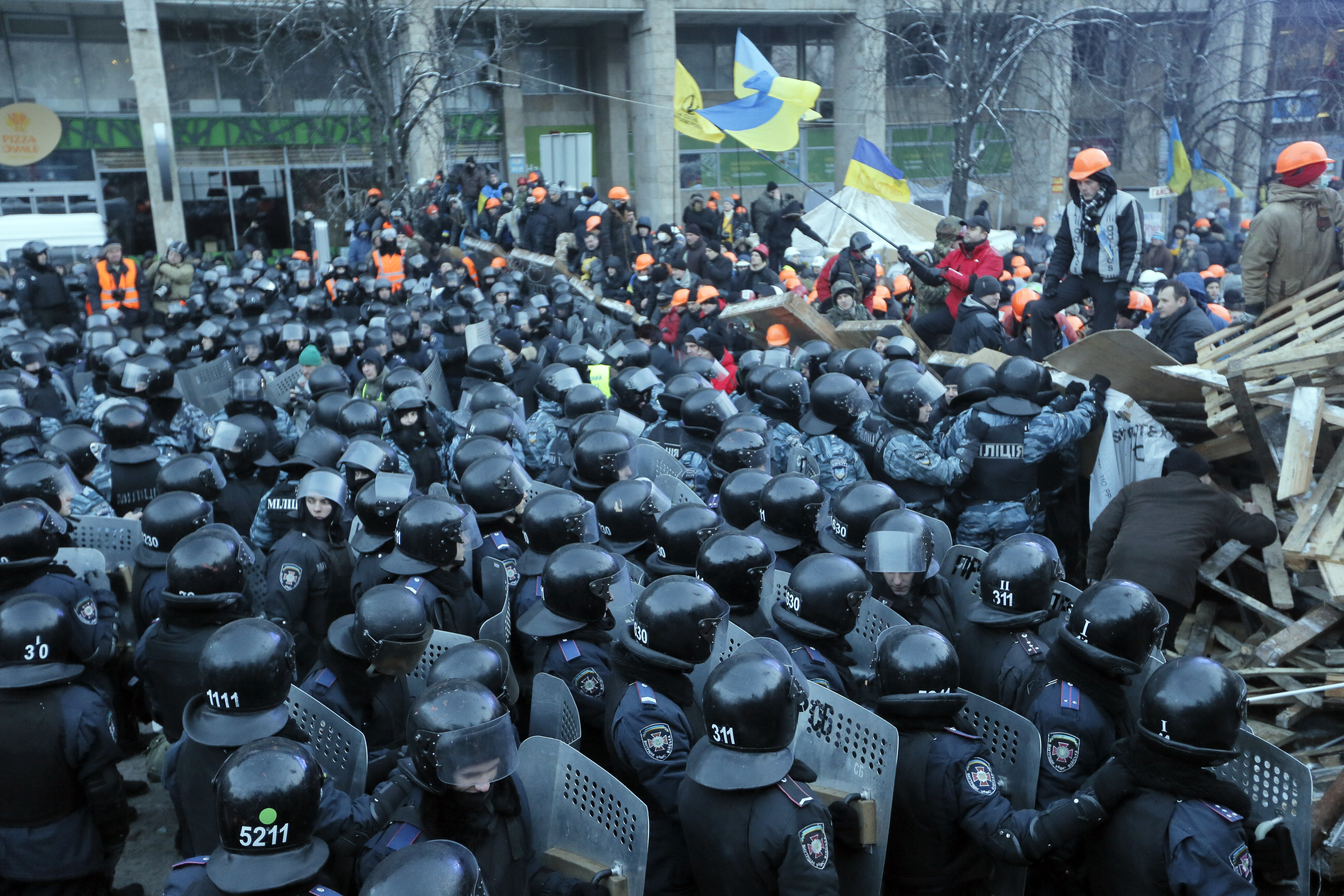
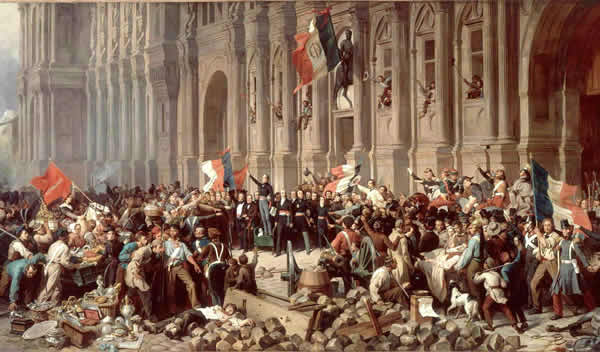
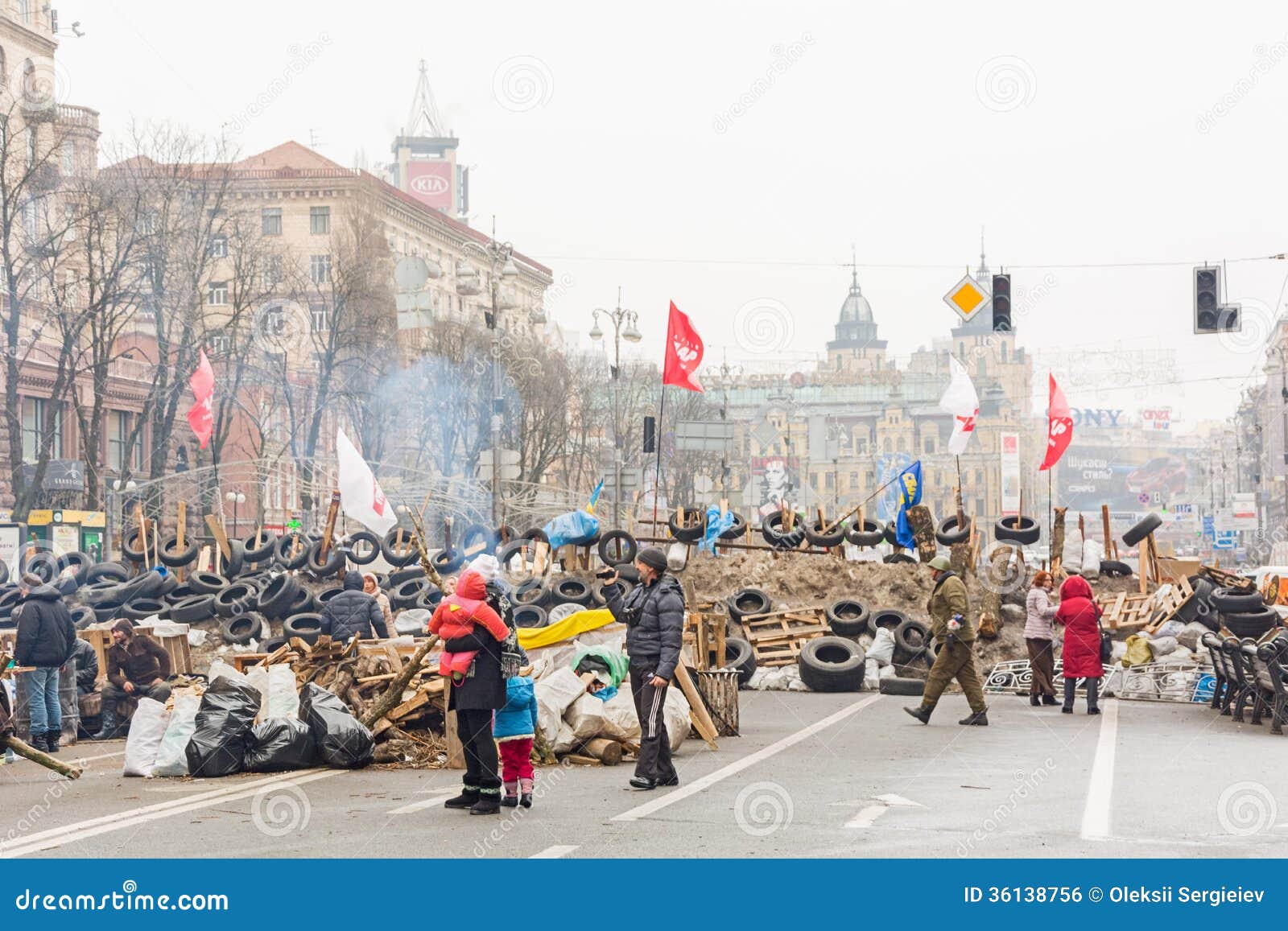
Why do the photos, video, and tweets out of Kiev have such mythic power? Why do demonstrations, and barricades, and people shot down, young and old, men and women alike, wring such enduring emotion (like Les Miserables)? Why do citizen risings in big, capital cities have such a hold on us?

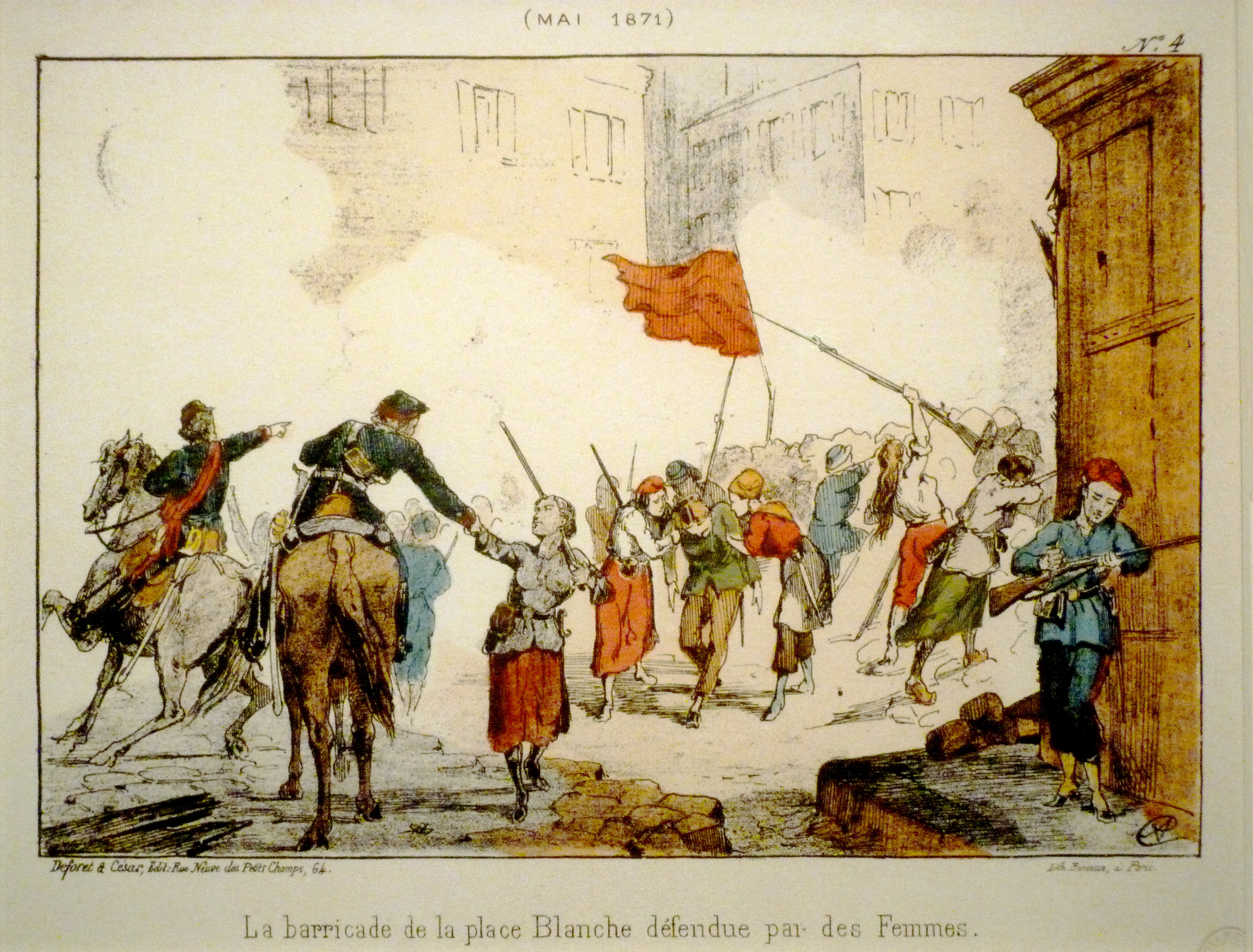
For a start, citizen-risings in cities are not war. Even when there is lots of fighting, it is never a fair fight, and we are rooting for the underdog, where the force against them is always unfairly superior, professional, and heavily armed. Plus a group of poorly armed citizens are unlike an army in almost every way. But especially this way — Together, they are the whole community: Men, women, and children fighting together. Their backs are against the family hearth itself. Nothing could be more existential, or more motivating.

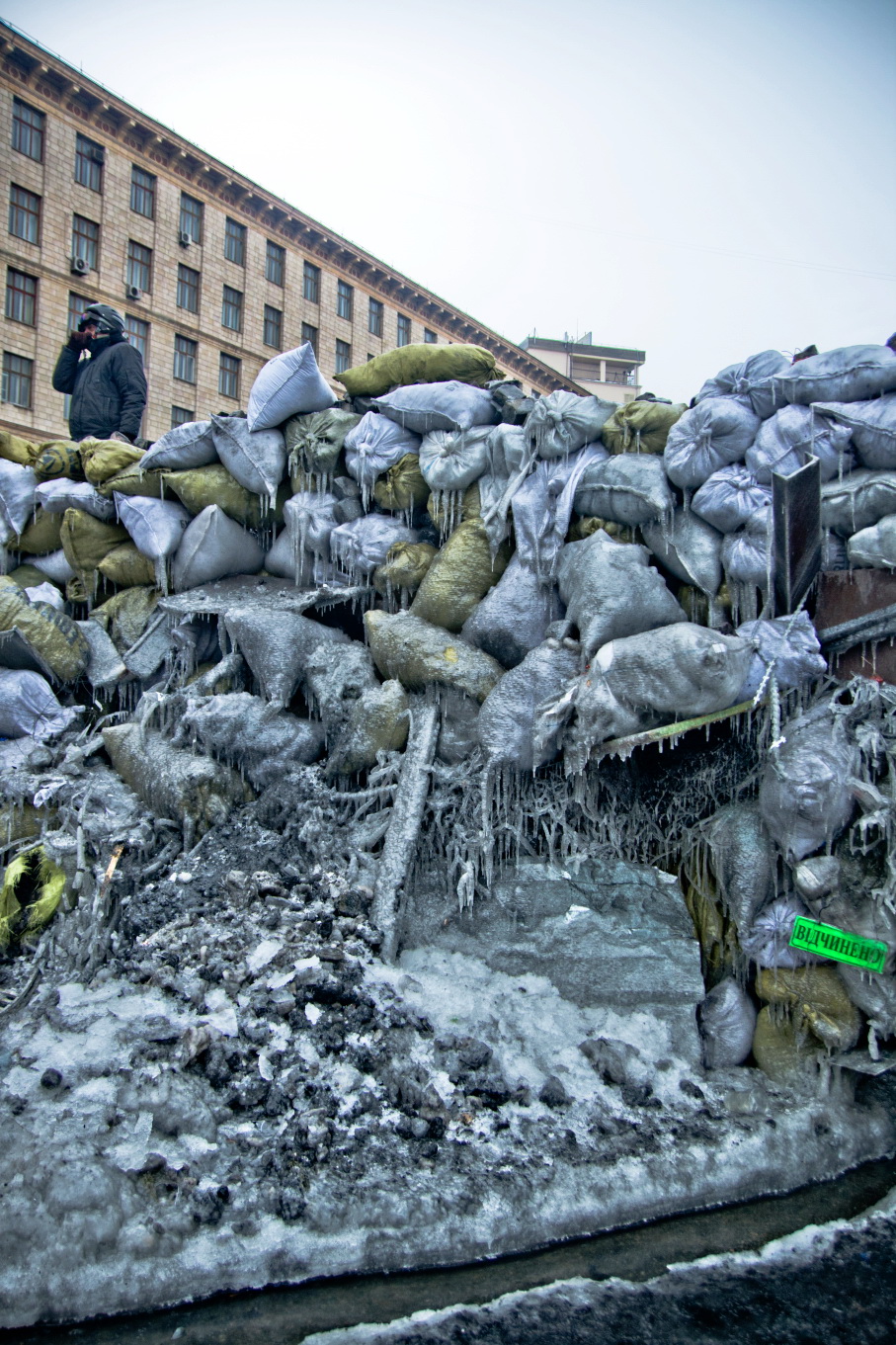
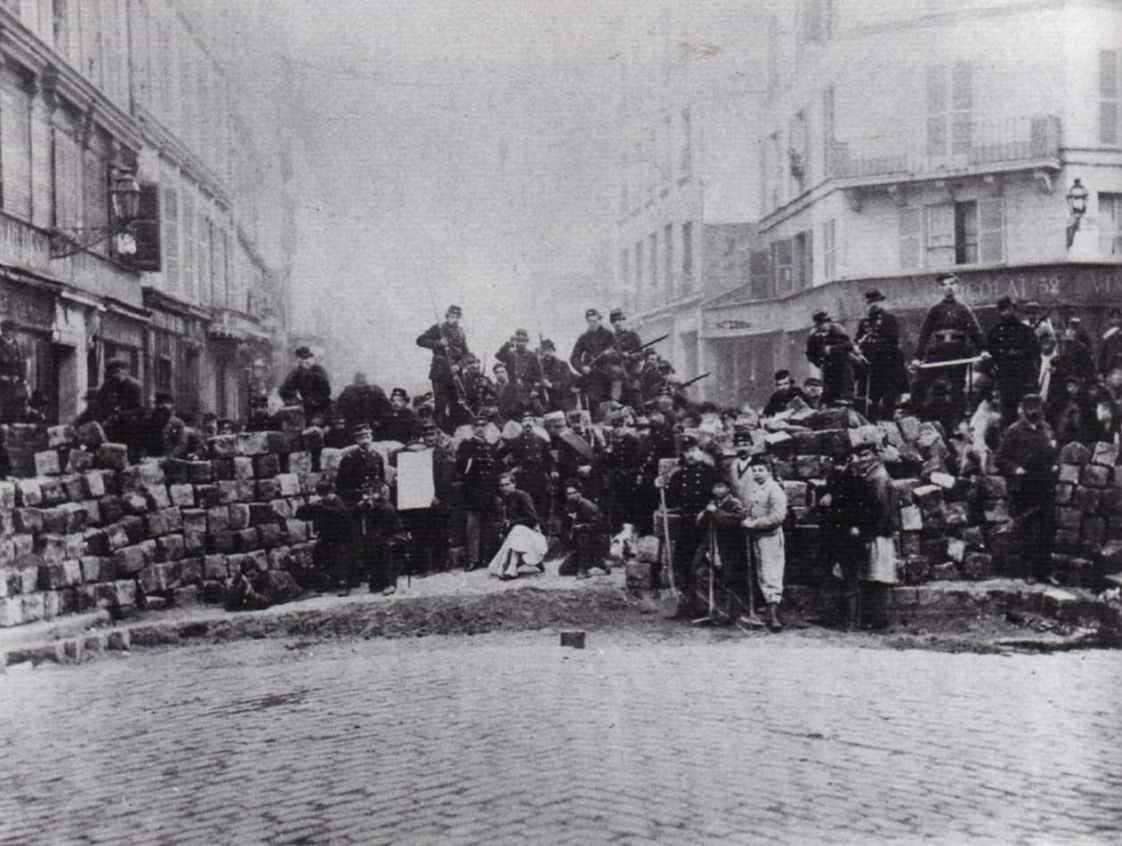
Hence their entire defense is an improvisation that seeks survival in destroying the very appearance of what they fight for, as they willingly demolish their homes (cutting passages and loopholes in their townhouse rows), their streets (ripping pavers and dragging their own vehicles into barricades), their centers of civic life — thus their very way of life — to resist the invader. Yet the material things of life mean nothing now compared to the preciousness of community and identity.

Because their defense is always existential — victory or death, freedom or slavery — and their enemy is always implacable and sure to win: If only they can kill enough.

Yet the mission of the citizen rising, though existential, is never hopeless, because the citizens know they can win through martyrdom.

The operational goal of the barricades is to successfully repel the armed might of the state — but the strategic goal is to overturn (or at least compromise) the very legitimacy of the state by forcing it to kill large numbers of its own citizens. This is why putting down a citizen rising is so risky for a state regime.

It is risky on two levels. On one level, soldiers will try to break down barricaded positions by killing civilians, reasoning that bravado — and thus resistance — will melt away as people see friends and family killed in front of them.

But this is the secret of community martyrdom: It cements social bonds stronger than any glue. In Kiev we have seen acts of heroism and sheer courage that convention typically associates only with soldiers in battle. Like the woman who tweeted after being shot in the neck, we have felt heartrending moments of pathos.

Truth is, a citizen rising that survives its first casualties (or atrocities) becomes potentially as strong as any army in any prepared, defensive position. Its barricades then suddenly are splendid field fortifications, the righteously occupied city blocks and squares like immoveable castles of concrete, rubble, and rubber.

So now the state’s arm of enforcement had better be an army, because they now face an army in a fortified place, ready to fight to the death.

But remember, these are still citizens of the republic, and the army of the republic cannot escape its sworn oath to defend them. And because the assembled and resistant are men and women and children together, killing them is like killing your own community: Your own family.

Moreover, a state that would wantonly kill its own people is not simply guilty of crimes against humanity: It is guilty (at least incipiently) of attempting to kill itself.

The state regime that will crush a citizen rising will also die if 1-If the injustice of state against citizen is real and deep, 2-If violence against protesting citizens was initiated by the state, and 3-If initial waves of citizen-martyrdom begin to psychically strip the state regime of its legitimacy.

Loss of legitimacy can be tracked through 1-How a “big push” to take the barricades fails extravagantly (and is covered extravagantly), 2-The rising spreads to other cities, 3-Police (or whole units) begin to join the resistance, 4-Regime elements (most especially the leader) leave the city, 5-International condemnation and regime sensitivity to it.

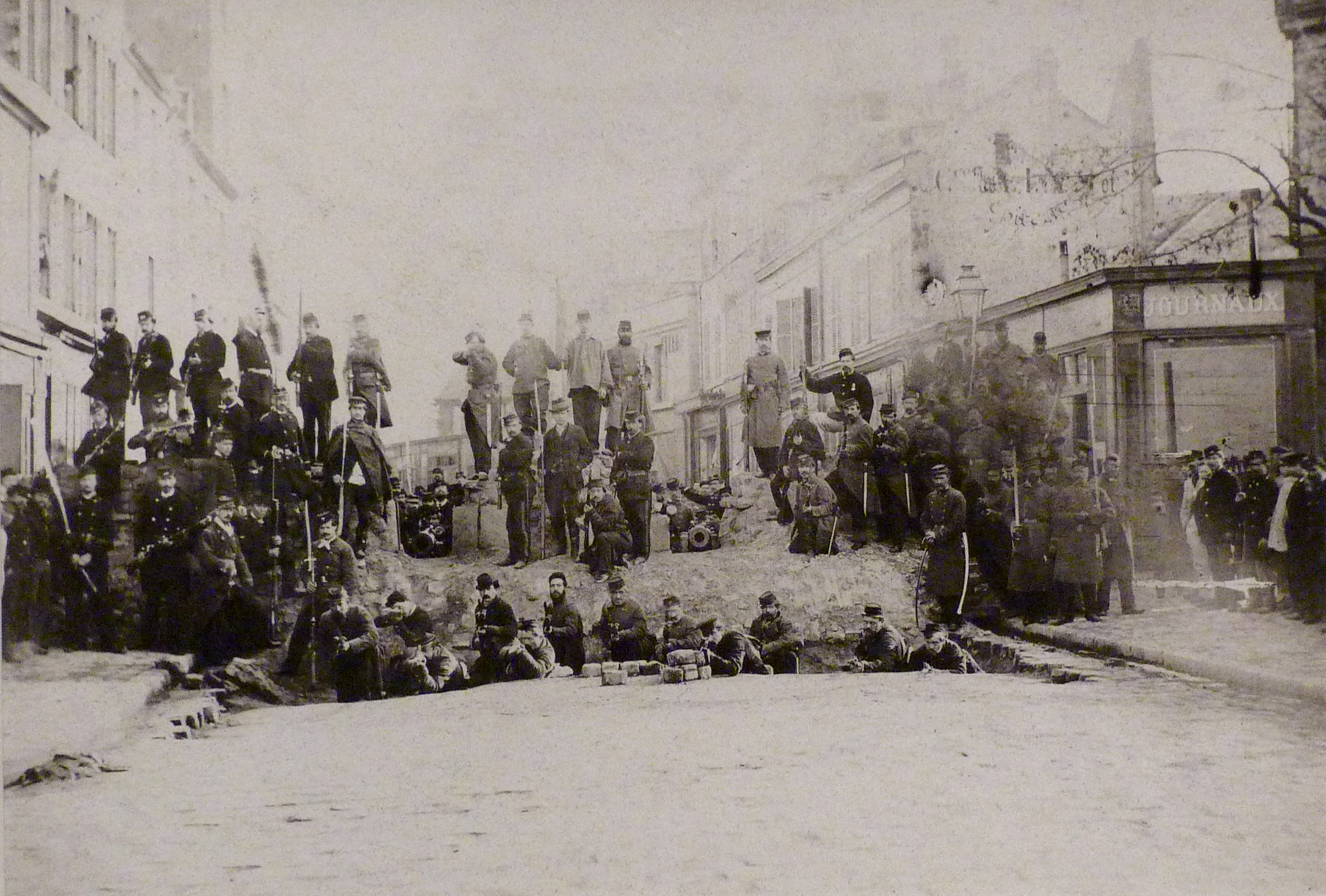
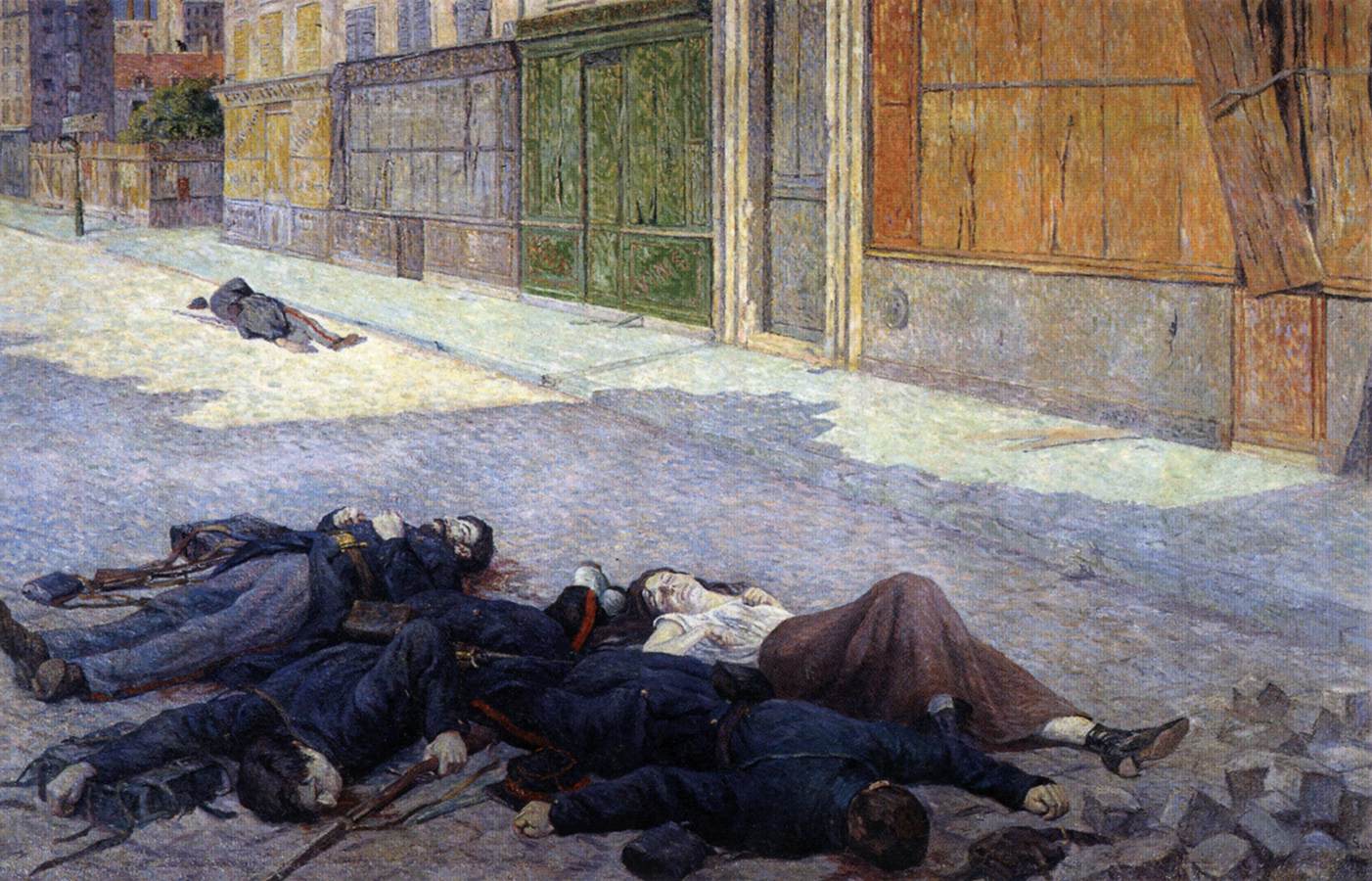
But for every glorious Tahrir Square moment — where world-dappled crowds toppled a Pharaoh — there is the counterpoint of the Paris Commune, where as many as 20,000 were slain [of 1.75 million Parisians, just to give a sense of scale]. For every hero city like Sarajevo, under sniper fire for nearly four years [15,000 dead out of 525,000, far worse than Paris], finally to be freed, there is Homs and Hama and Aleppo and Damascus, whose dead will be mourned, yet not reckoned, until another time.

These examples, tragically, tell us not simply how regimes can die in the face of citizen rising, but also how they can survive and even triumph — through the worst means available to humanity. Here we must face the political utility of mass atrocity.

Mass atrocity is the only way out of the legitimacy dilemma posed by a citizen rising, fortified, in the capital city. Consider: If the state here appears to do nothing, it begins to go down. If the state accommodates, it begins to go down. If the state kills many resistant citizens, the martyrdom effect begins to take it down. If the state assaults the barricades and fails, it begins to go down.

The only alternative is to crush the insurrection. From the state standpoint, this achieves prompt good effects: 1-Citizen leadership is wiped out, 2-The main fighters are all dead, meaning that 3-All the others are left stunned and numbed into submission. Spirit broken: Goal achieved.

The last effect is the worst: 4 — The destruction of martyrdom itself. Remember that in citizen risings, it is the initial spasm of sacrifice that is politically the most powerful. Continuing mass sacrifice can also keep strengthening the cause — like the endless siege eventually forcing NATO’s hand — but citizen resistance must preserve its operational effectiveness — to show that resistance cannot be crushed.

Hence the mission of mass atrocity is to tell the citizen rising that the state no longer cares — that they are no longer considered citizens or even human. The state will kill all who resist. Effectively the state has now created an alternative basis for legitimacy, disconnected from the political compact, now forever broken, of people-to-state. Having lost the original source of its power — its own people — then that state creates a new power in its inalienable right to kill. If the state can survive its own, elective choice for mass killing, acquiescence by its people (and the international community) becomes in itself a new source of legitimacy: “Your precious martyrdom has no meaning anymore.”

Hence, a brutal-minded state regime will focus on a quick decision, like the French Republic’s slaughter of the Paris Commune in 1871. But the French people said go for it, so a new republican political compact was preserved — in a way.

A more troubling example is the Assad regime. Its initial force majeure failed, and a broad-based citizen resistance rose up in major cities. Yet powerful allies like Hezbollah, Russia, and Iran, have kept the regime alive through better, if ruthlessly inflicted, force majeure. But it is the ironical and timorous strategic reversal of the international community — calling for Assad’s ouster, and then actually working with the regime after its chemical weapons’ use — that has served to actually legitimate it.

So we — meaning, the United States above all — have anointed the strategic effectiveness of mass atrocity [in a place, Syria, where we could care less], just as we celebrate from our couches the still-abiding power of urban resistance and martyrdom [in a place, Kiev, we pretend to love].